Epitools description#
In
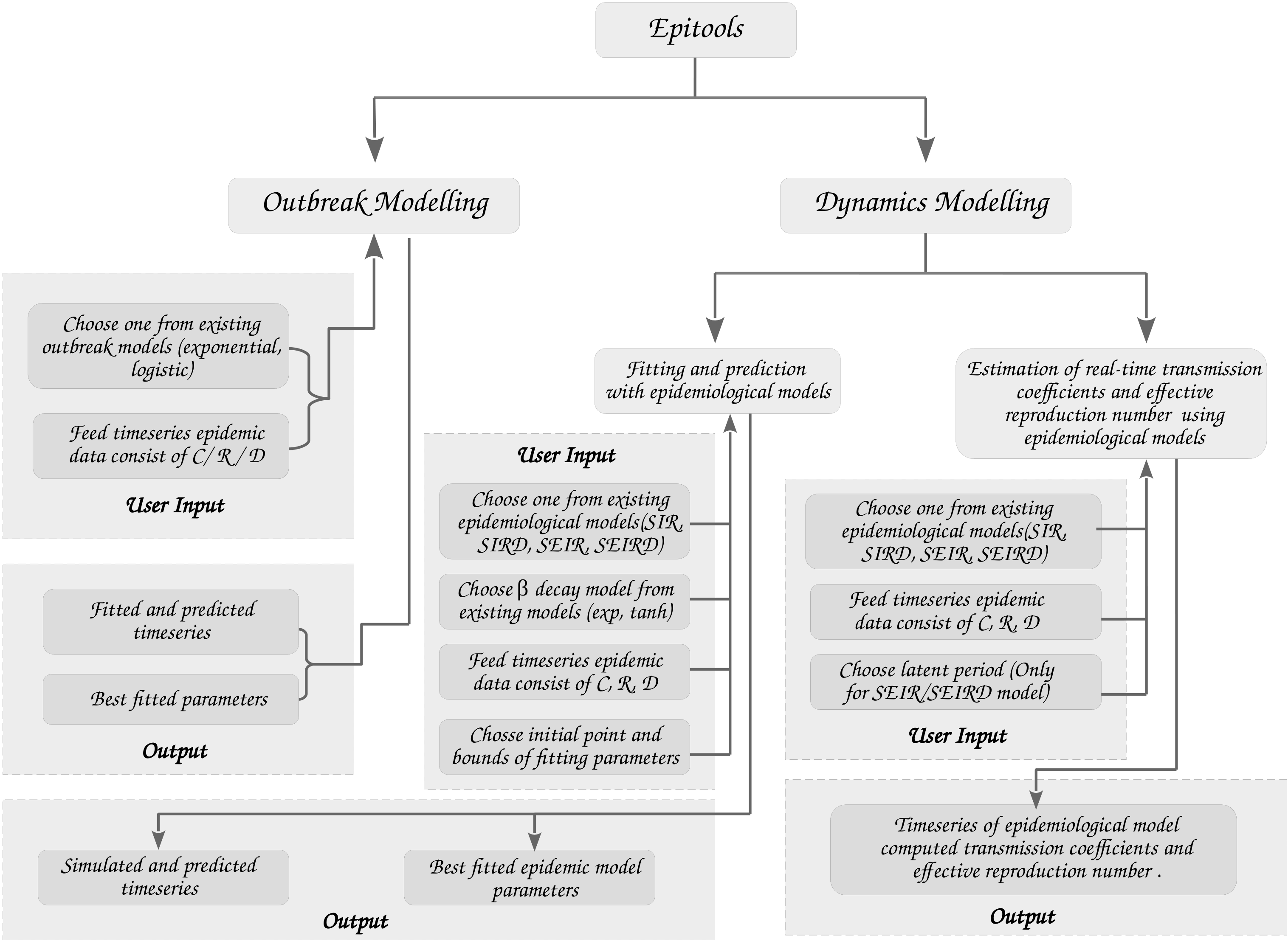
Epitoolswe implemented different outbreak models (exponential, logistic) and different epidemiological models (SIR, SIRD, SEIR, SEIRD) with time-dependent contact rate (\(\beta\)) models (polynomial, exponential, tanh, power law) for efficient modelling and forecasting Epidemics. The following tutorial covers different functionalities ofEpitools. The examples of workflows reproduce the analysis will be published in Manik et al. (2023)
Flowchart of Epitools usage#
Modelling and forecasting epidemic#
It consists of 4 main classes, EpiGrowthModel, estimate_tc, EpiDynamicsModel, estimate_r. We have discussed the usage of each class in the relevant sections below.
Simulations#
let’s simulate different models of Epitools with some dummy datas first.
So let’s import Epitools other required packages first:
>>> from epitools import *
>>> import pandas  as pd
>>> import numpy as np
>>> import matplotlib.pyplot as plt
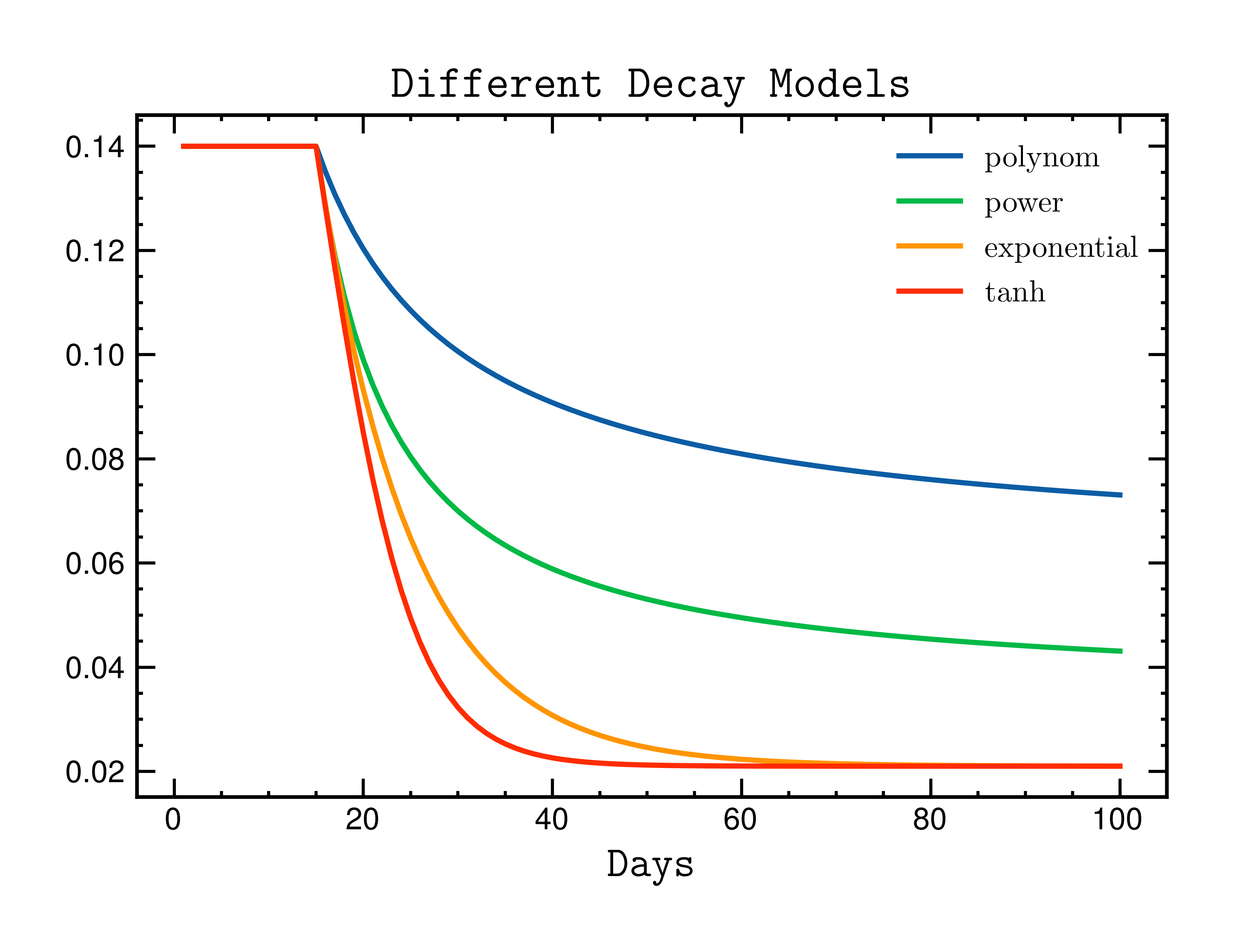
Simulation of different types of time-dependent \(\beta\) models.
Example dataset#
Suppose we have a test epidemic data in the following form :
date |
Confirmed |
Recovered |
Death |
|---|---|---|---|
2021-02-01 |
10766245 |
10448406 |
154486 |
2021-02-02 |
10777284 |
10462631 |
154596 |
2021-02-03 |
10790183 |
10480455 |
154703 |
2021-02-04 |
10802591 |
10496308 |
154823 |
Here we used the COVID-19 data of India during 01-02-2021 - 04-08-2021 which can also be downloaded from here . Now we will try to model this real time data with different outbreak and dynamical epidemiological models from Epitools . The data can be aquired from here.